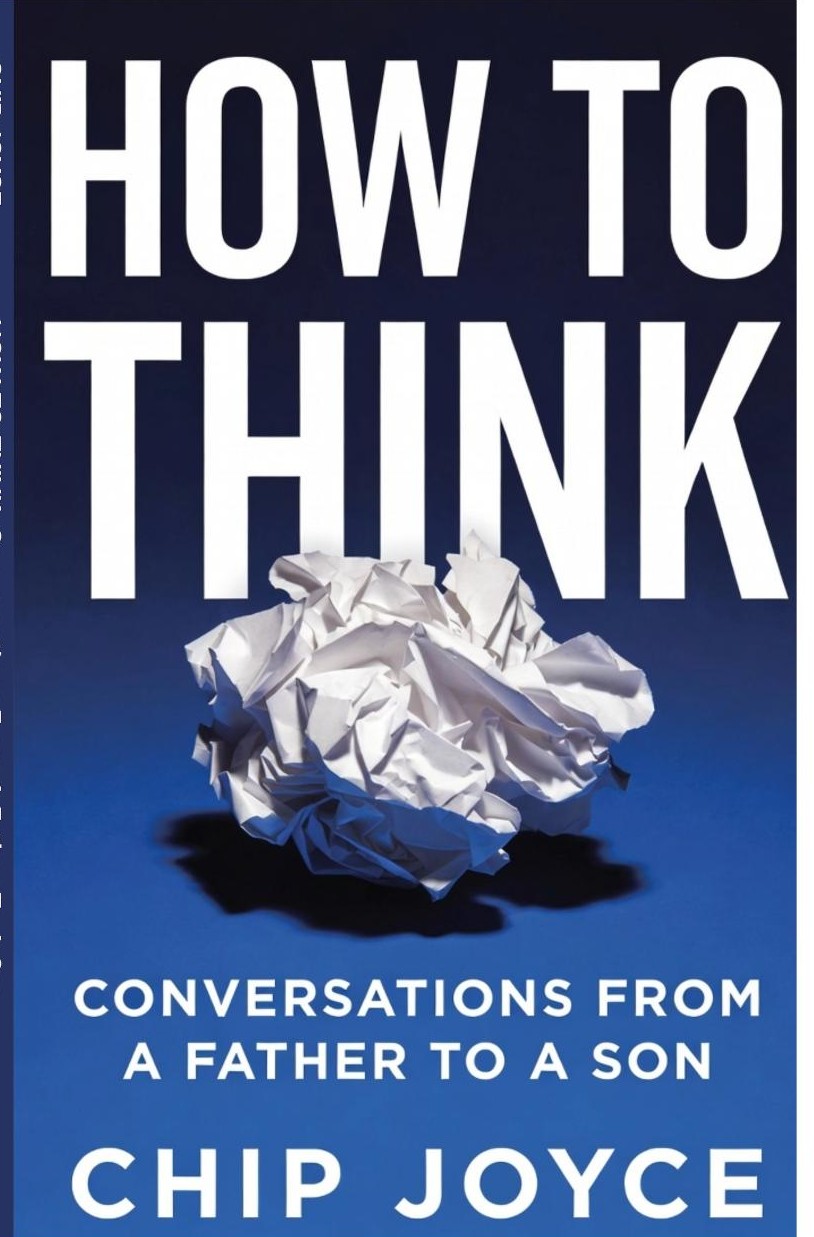
How to Think
Conversations from a Father to a Son
Nobody teaches you how to think. Not systematically, not as a practice you can develop. Schools teach the conclusions of other people’s thinking—the findings of science, the results of history, the established methods of established disciplines. The thinking itself is left to be picked up by accident.
There is a standard. It comes from the physicist David Deutsch, and it fits in a sentence: a good explanation is hard to vary. A bad explanation can be adjusted to accommodate any evidence at all, which is why it survives everything and predicts nothing.
How to Think is twelve conversations between a father and a son, each one developing a practice that standard demands—seeing for yourself, asking better questions, evaluating evidence, learning from being wrong. It does not simplify and it does not condescend. A young person who reads it carefully will have a standard rather than a set of techniques, which is the only kind of education that compounds.
You already know the feeling.
You’re in the middle of something—a movie everyone loves, a trend everyone’s following, an idea everyone accepts—and something doesn’t quite add up. Not dramatically. Not enough to say anything. Just a small, quiet signal: this doesn’t feel right to me.
And then you override it. Because twelve people in the group chat said it was great. Because the reviews are good. Because questioning it out loud would make you the difficult one in the room. Because maybe you’re missing something. Because everyone else seems fine.
So you go along. And the feeling fades. And later—sometimes much later—you find out the feeling was correct.
This happens to all of us. It happens constantly, and most of us have learned, through years of practice, to dismiss that signal before it becomes inconvenient. We have trained ourselves out of one of the most important cognitive capacities we have.
I want to talk about why that’s a mistake. Not a small, personal mistake—the kind that costs you a bad movie recommendation. A consequential one. The kind that has killed people, derailed careers, and kept entire institutions wrong for decades when the evidence to correct them was sitting in plain sight.
The ability to see clearly—to form your own hypothesis about what’s actually in front of you, independent of what you’ve been told to expect—is the foundation of everything else in this book. Get it wrong and all the other tools are compromised. Get it right and you have something most people never develop: a direct, honest relationship with reality.
In 1846, a young doctor named Ignaz Semmelweis took a position at the Vienna General Hospital and noticed something that should have been obvious to everyone: women giving birth in the ward staffed by doctors and medical students were dying of childbed fever at three to five times the rate of women in the ward staffed by midwives.
The mortality rate in the doctors’ ward ran as high as eighteen percent some months. In the midwives’ ward, it was consistently around two to four percent. Women knew this. They would beg, sometimes in tears, not to be assigned to the doctors’ ward. Some chose to give birth on the street outside rather than be admitted to it, and their outcomes were better. The pattern was not subtle. It was not hidden. It was visible to anyone who looked at the numbers, which were recorded meticulously and available to every physician on staff.
Almost nobody looked.
The rest of the conversation is in the book.
Set in Minion Pro