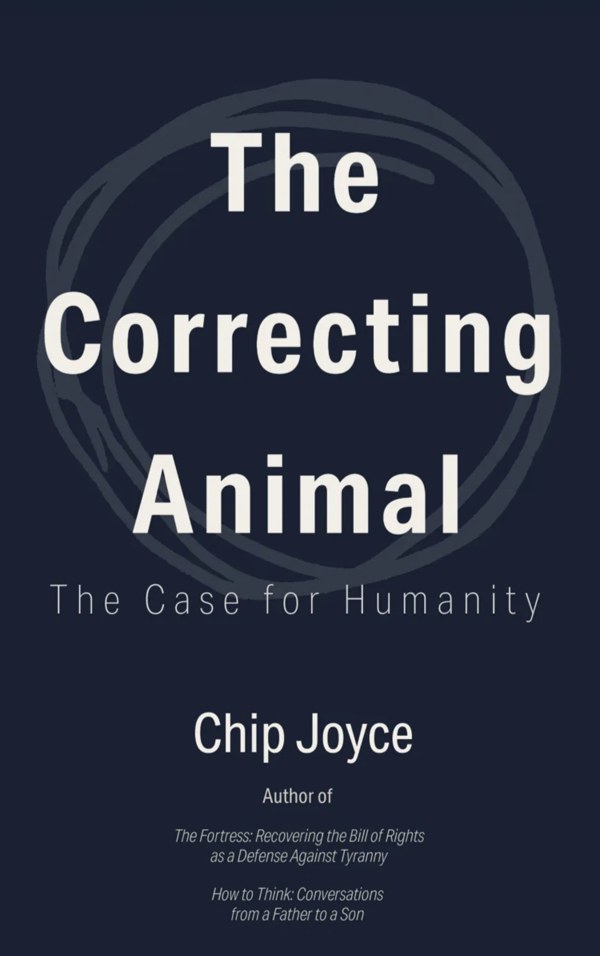
The Correcting Animal
The Case for Humanity
There is a case against humanity, and it is not a weak one. The strip mine, the death camp, the ordinary year in which we drive to extinction animals we never troubled to name. Some who follow the charge to its end conclude that the decent thing would be to stop.
The Correcting Animal concedes the crimes. All of them, without discount. Its quarrel with the prosecution is about something stranger: that the case has never once looked at the defendant. Contempt for humanity is available only at a distance, from a population figure or a carbon total. Almost nobody arrives at it while looking at a human being.
What the looking finds is a creature born without answers, issued almost none of the instincts that carry a horse through its first day, and forced by that helplessness to guess, check, and correct. That loop is how a naked, slow animal came to cure its own diseases and weigh the galaxy. It is also where good and evil come from, for a creature built this way.
There is a case against humanity. It runs like this. We are the one creature that has ever put the whole living world at risk—a planetary force with the appetite of a plague, turning forest into parking lot and reef into bleached bone, driving to extinction, in an ordinary year, animals it never troubled to name. We are the species that built the death camp, the strip mine, and the land mine. Some who follow the thought to its end arrive at a quiet conclusion: that the decent thing would be to stop, that to bring a new human into the world is to draft an innocent into a life of consuming and suffering, and that a planet rid of us would not grieve. The oldest form of the charge was written into scripture: that we arrive already fallen, marked, guilty before we act. The newest form is written into essays with good footnotes. Across all of them the verdict holds, and it has hardened into the reflexive good taste of the educated world. To speak well of our kind, in a great many rooms, has become the position that owes everyone an explanation.
This book is the case for the other side.
The defense will not proceed the way such cases usually do, by denying the charges. The charges are, for the most part, true. We have done every terrible thing on the list and a number the list leaves out. The defense concedes the crimes at the outset, all of them, without discount. Its quarrel with the prosecution is not about the evidence of our cruelty. It is about a stranger and more basic failure, the one that turns a catalogue of real crimes into a verdict on a whole kind of being. The prosecution has never once looked at the defendant.
That is not a figure of speech. Contempt for humanity arrives the same way every time—by looking away from human beings and toward an abstraction: a population figure, a carbon total, a species-level rap sheet, a graph bending the wrong way. It is a conclusion about a category, and it is available only at a distance. Almost no one comes to despise humanity while looking at a human being. Sit with one child working out that the moon seems to follow the car, or one stranger going into a burning building for someone he has never met, and the contempt has nothing to attach to. It requires the aggregate and forbids the particular. It is, in the most literal sense, a refusal to look at what it claims to have judged.
Which is the defense’s whole method in one word: look. Describe the creature fully—not the crimes alone and not the glories alone, but the thing entire, how it is built and how it works and what it does that nothing else in the known universe does—and let the verdict wait until the looking is done. Judgment that comes before description is not judgment; it is prejudice. And the description, fully carried out, settles the case on its own, because you cannot see clearly what a human being is and go on holding it in contempt.
Begin with the creature.
The description can be put in a few words. A human being is the correcting animal. It arrives more unfinished than any other creature that survives at all, issued almost none of the fixed instincts that carry a horse or a hatchling through its first day, and this helplessness, which looks like the deepest of our curses, is the hinge on which everything turns. Because a creature born without answers must make them. It must guess—throw a conjecture at a world it does not understand—and then do the one thing that turns a guess into knowledge: check it against reality and correct it when it fails. That single loop, run from the crib to the deathbed and handed down across ten thousand generations, is the whole engine. It is how a naked, clawless, slow animal came to cure the diseases that were killing it, weigh the galaxy, reconstruct the first second of the universe, and stand on a world onto which it was not born. We do not survive by being right. We survive by being able to find out when we are wrong.
The answer takes twenty chapters.
ISBN 979-8-9974020-1-3
Set in Minion Pro